Brazil Fan Travel
Is Brazil Safe for World Cup Travelers? Practical Tips for 2027
Quick answer
Brazil is manageable for fans who follow a short list of precautions, but it is not risk-free. The U.S. rates it Level 2 of 4, "Exercise increased caution," and the UK and Canada warn mainly about street robbery, drink spiking and unofficial taxis. The U.S. page names no World Cup stadium among its areas to avoid. Below: the habits that matter, emergency numbers and tourist police.
On this page
- What do the U.S., UK and Canada say about Brazil?
- Which areas should you avoid?
- What are the most common problems for visitors?
- How do you get to the stadium and back safely?
- How do you protect your money and cards?
- How do you avoid drink spiking?
- Who do you call in an emergency?
- What about protests and big crowds?
- What should you do before you leave home?
- What is still not decided?
- FAQ
- Sources
Almost every guide to the 2027 Women's World Cup ends up asking the same question: is it safe to go? I am based in Salvador, a host city, and I am not a security expert, so I will not answer on my own authority. I read what three governments publish for travelers and put it in a form you can use on a match day.
The short version is that official advice for Brazil is specific, and almost all of it is about ordinary street habits. I have no connection to FIFA or to any government agency. For the rest of your planning, my trip-planning guide covers base cities, weather and health.
What do the U.S., UK and Canada say about Brazil?
I read each government's page on October 30, 2026. They use different scales, so I kept each one's own words.
| Government | Rating | Date on the page | Main reasons |
|---|---|---|---|
| United States | Level 2: "Exercise increased caution" | Issued Aug. 31, 2026 | Crime, kidnapping |
| United Kingdom | Advises against all but essential travel only to parts of Brazil (river areas in western Amazonas State) | Updated Oct. 28, 2026 | Robbery, express kidnapping, drink spiking, armed groups on those rivers |
| Canada | "Exercise a high degree of caution (with regional advisories)" | Updated Oct. 26, 2026 | High crime rates, gang-related violence in urban areas |
Official travel advice for Brazil from three governments, as read on October 30, 2026.
Read together, they do not say "stay away." They say Brazil's cities have real street crime and that a handful of places are off the list for visitors. The pages can change, so open the U.S. advisory before you book.
Which areas should you avoid?
The U.S. advisory has a "Do not travel" list with three items: international land borders (crime and kidnapping), informal housing developments such as favelas (crime), and the satellite cities around Brasília (crime). It also says U.S. government employees need special authorization to go near the borders, with exceptions for Foz do Iguaçu and the Pantanal, and to enter four Brasília districts between 6 p.m. and 6 a.m.
The UK is more direct about favelas: it says to avoid all of them, "including favela tours marketed to tourists" and any hotel, restaurant or bar advertised as being inside one. Canada tells travelers to avoid all travel to two named areas of Rio, Complexo da Maré and Complexo da Penha, and to avoid non-essential travel within 20 km of most land borders.
None of these lists is a list of stadiums or hotel districts. The U.S. page names no World Cup stadium. Before you book a room, I would search the address on a map and check that it is not inside one of the areas above.
What are the most common problems for visitors?
Street theft, and the three governments agree on the same short list:
- Phones. The UK says thieves target mobile phones, "particularly between 4pm and 9pm," and advises against using a phone in the street. Canada says to avoid using your phone in public, and that thieves target people who appear wealthy, such as those with phones and laptops.
- Do not resist. The U.S., the UK and Canada all say the same thing: if someone robs you, hand it over. Canada adds that victims have been seriously hurt when they resisted.
- Beaches after dark. The U.S. says to avoid walking on beaches after dark, and the UK says not to go onto city beaches after dark. The UK also describes "arrastões," when groups of thieves sweep across a beach grabbing belongings.
- Buses. The U.S. says passengers are at higher risk of robbery or assault on public buses, and advises its own employees not to use municipal buses. The UK says robberies are common on buses. Canada flags pickpocketing at bus and subway stations.
- Showing wealth. The U.S. advises against wearing expensive watches or jewelry.
Recife has a different warning: the UK and Canada both mention sharks at its beaches, and Canada says to be wary of them, especially in the northeast near Recife. If your trip includes the Northeast, that is worth knowing before you swim.
My read of those lines is simple. On a match day I would keep the phone in a front pocket, not in my hand, and take it out only when I need the ticket at the gate.
How do you get to the stadium and back safely?
Transport is where the official advice is most concrete. The UK says not to hail taxis on the street, that there are authorized taxi booths at most Brazilian airports, and to book through the official app, then check that the car's registration and the driver match the app. Canada says the same in other words: use officially marked taxis, and confirm the driver's identity and license plate before you get in a ride-share car.
Both warn that the danger is not only theft. The UK reports express kidnappings, assaults and robberies from unlicensed taxis, including cars using fraudulent ride-hailing accounts. For a stadium trip, that means one rule: the car you get into should be the car on your screen.
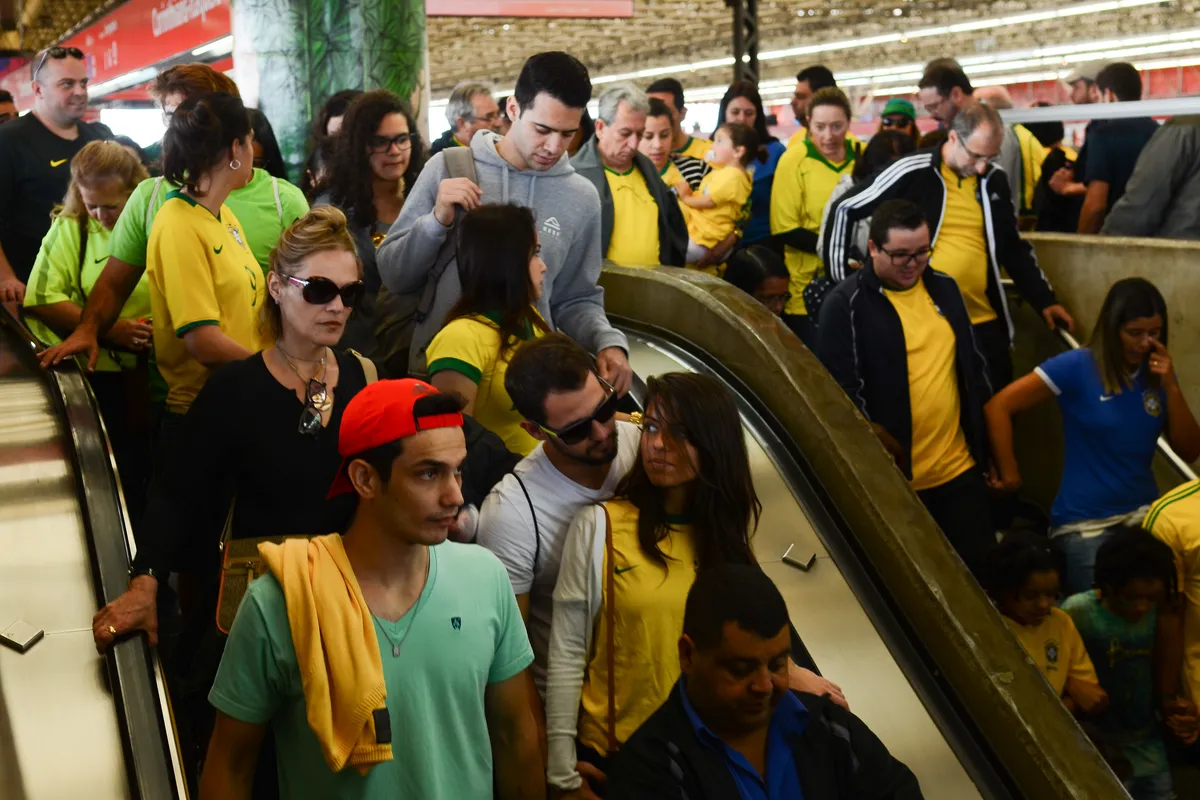
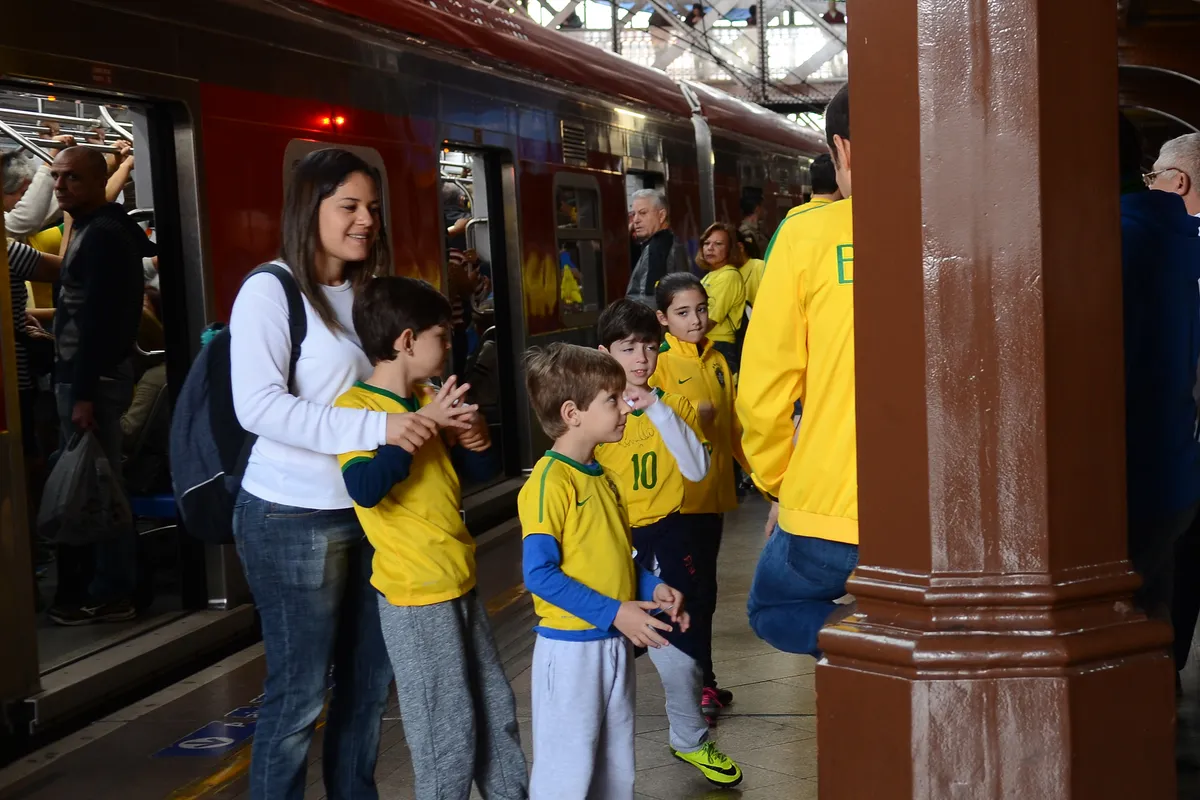
Trains and metros are a different case. The U.S. says to be careful at major transportation centers or on public transport, especially at night. The UK reports theft and robbery on rail networks, including urban metro lines, and advises not to use a phone during a train ride. Both fit crowded match-day stations like the one in the photo above, which shows fans on their way to a women's Olympic match in São Paulo in 2016.
Fix your way back before kick-off. Official transport plans for the 2027 matches are not published yet, so I would not count on a special service until each host city announces one. If it is late and you are unsure, the UK and Canada advice points to an app car with the plate confirmed, not a car at the curb.
How do you protect your money and cards?
The main risk the U.S. names here is express kidnapping, in which victims are forced at gunpoint to withdraw cash from several ATMs or to transfer money with a banking app, commonly Pix. It says this threatens locals and foreigners alike. Kidnapping for ransom involving U.S. citizens is rare, it adds, but it does happen.
The advice is practical: use ATMs inside shopping malls or major hotels, vary your routes and travel times, and stay alert when you visit a bank. Canada says to use ATMs in public areas or inside a bank or business, and the UK says not to use an ATM if you notice anything suspicious. Canada also advises against paying by card in unofficial taxis. I would carry one card and some cash in the pocket and leave the rest at the hotel.
How do you avoid drink spiking?
This is the one problem all three governments connect to nightlife. The U.S. calls drugged drinks common, above all in Rio de Janeiro, and says criminals pick out foreigners through dating apps or in bars. It advises you to avoid going to bars or nightclubs alone, not to accept food or drinks from strangers, and to always watch your drink.
The UK's version: buy your own drinks and keep them in sight, and if you feel strange, sick or drunk after only a couple of drinks, tell a trusted friend or security staff. Canada suggests ordering drinks in sealed bottles or cans instead of plastic cups. The UK also has a separate warning about methanol in counterfeit alcohol, which it says can kill even in small amounts. After a match, the safest plan is the simplest: go out with the people you came with.
Who do you call in an emergency?
Brazil's emergency numbers are short and free. Anatel, the telecom regulator, says all calls to public emergency services are free, and Brazil's Ministry of Communications describes what each one is for.
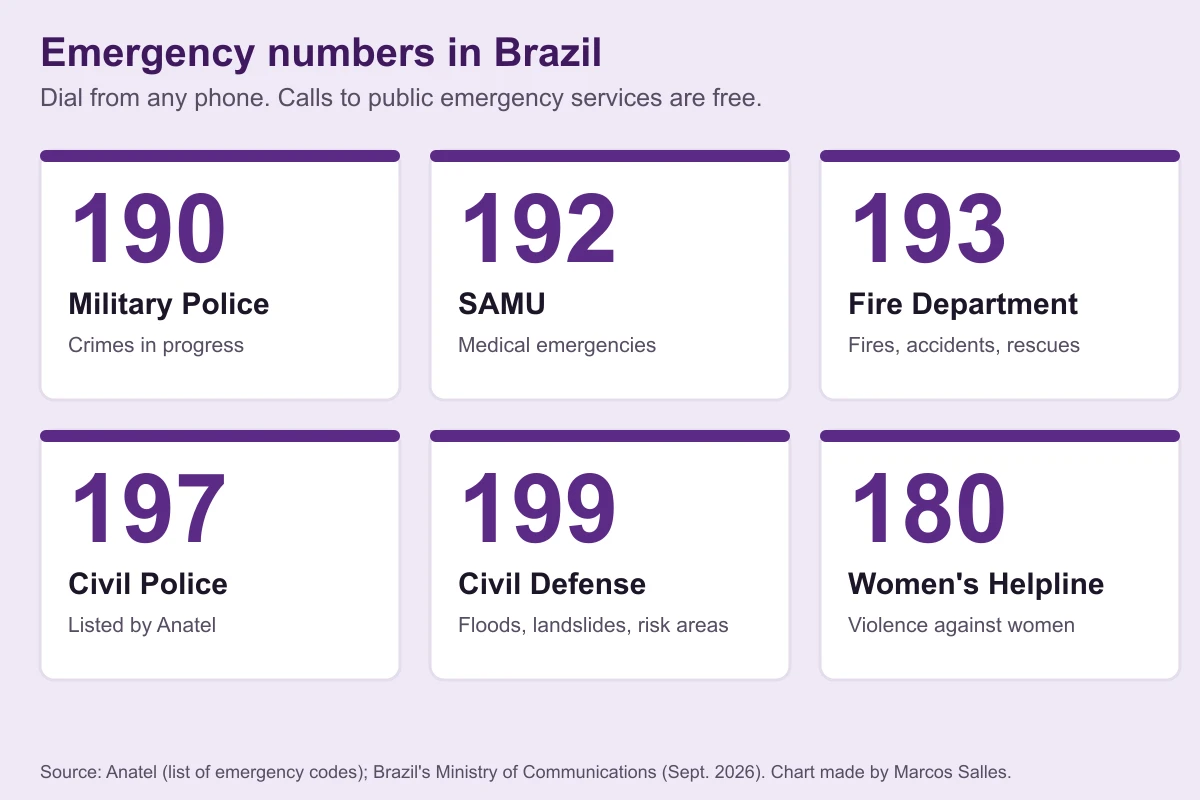
For a crime in progress, 190 is the number, and it is also the one the UK gives. For a medical emergency, 192. Anatel's list also shows 112 and 911 as Military Police numbers that work only from cell phones.
After a theft, the next stop is a tourist police station. I checked three cities with the official pages I could open:
| City | Station | Address | Phone | Hours published |
|---|---|---|---|---|
| Salvador | DELTUR Barra | Rua César Zama, s/n, 14th Territorial Police building, Barra | (71) 3116-0065 | 24 hours |
| Salvador | DELTUR Airport | Salvador International Airport | (71) 3116-1631 | 24 hours |
| Rio de Janeiro | DEAT | Av. Afrânio de Melo Franco, 159, Leblon | (21) 2332-2893 / 2332-2887 | Not stated |
| São Paulo | DEATUR | Rua Cantareira, 390, Centro | (11) 3257-4475 | Not stated |
Tourist police stations in three host cities, as published on the pages I read on October 30, 2026. Confirm hours before you go.
The Bahia Civil Police page for DELTUR Barra says it takes reports about tourist protection in the capital and asks for an official photo ID. It also says reports can be filed online at the Sinesp virtual police station. The Rio details come from Riotur's list of useful information (August 2024) and the São Paulo ones from the city tourism department's FAQ, so I would call before you go. I did not check the other five host cities, and I will add them as I confirm each one.
The U.S. Embassy in Brasília lists +55 61 3312-7000, and +55 61 3312-7400 for emergencies after hours. The U.S. advisory also recommends enrolling in the Smart Traveler Enrollment Program (STEP) to receive embassy alerts.
What about protests and big crowds?
All three governments say demonstrations happen often in Brazil. The U.S. embassy's tip is to avoid them because they can become violent. The UK says police have used rubber bullets and tear gas to disperse protesters, and Canada says even peaceful demonstrations can turn violent at any time and advises avoiding areas where large gatherings are taking place.
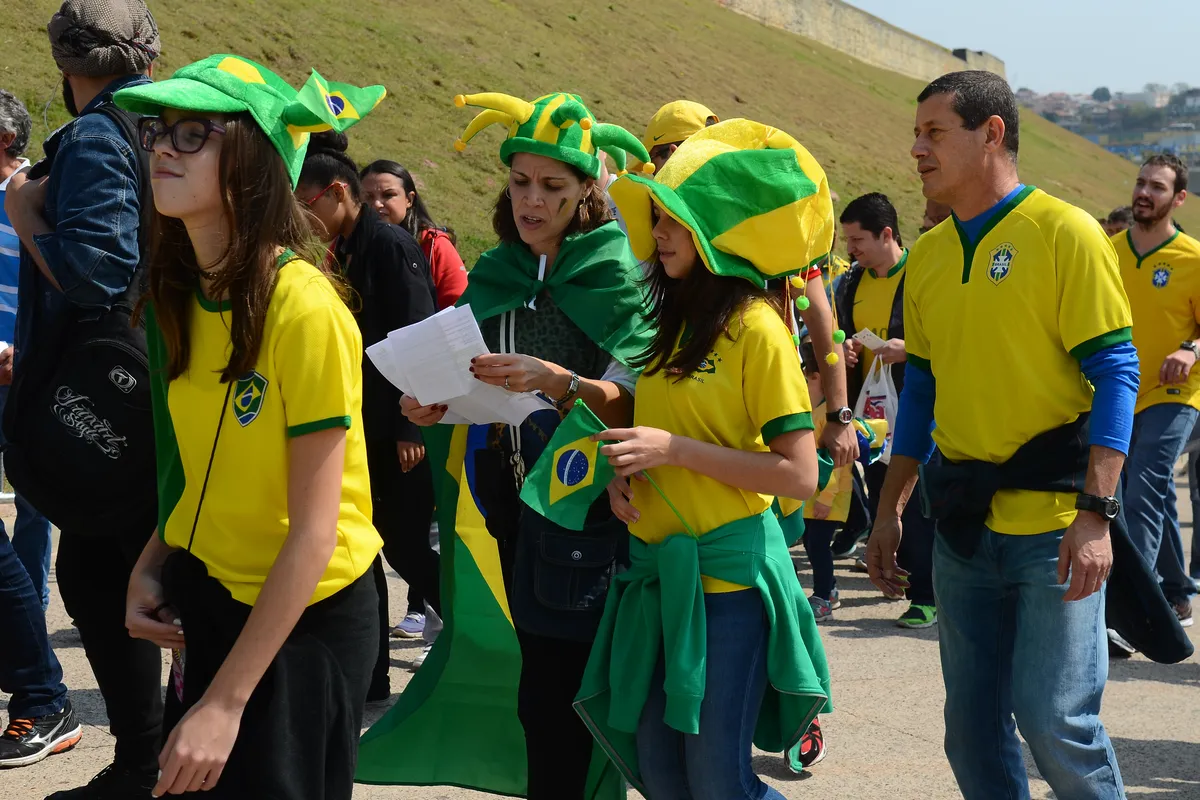
A football crowd is not a demonstration, and the pages do not say it is. The practical point is narrower: if you see a march or a large gathering that is not the match, change your route.
What should you do before you leave home?
The U.S. advisory has a short checklist, and most of it takes minutes:
- Enroll in STEP to receive embassy messages and alerts, which also makes it easier to locate you in an emergency.
- Share your itinerary with a family member or friend, and agree how you will confirm you are safe: text or calls, how often, and who you contact first.
- Buy travel insurance. The U.S. says it "highly" recommends it, and to ask the insurer about evacuation assistance, medical insurance and trip cancellation coverage.
- Check the CDC's health page for Brazil. My travel guide covers the yellow fever advice.
- Sort the paperwork first. U.S. citizens need an e-visa, covered in my visa guide, and tickets are explained in the ticket guide.
What is still not decided?
Two things matter for safety and neither is announced: the match-day transport and security plans for each host city, and the Fan Festival sites. Match schedules by city will only be set after the December 11, 2026 draw. I will revise this page once the host cities publish their plans, and whenever one of the three governments changes its advice. For where to base yourself, see my guides to Salvador and Rio, the tournament schedule, and all the guides in Brazil Fan Travel and World Cup 2027.
Frequently asked questions
Is Brazil safe for tourists in 2027?
It is manageable with precautions, but not risk-free. The U.S. rates Brazil Level 2 of 4 ("Exercise increased caution"), citing crime and kidnapping, and the UK and Canada warn about street robbery, drink spiking and unofficial taxis. The advice is mostly about everyday habits.
What is the U.S. travel advisory level for Brazil?
Level 2 ("Exercise increased caution"), issued on August 31, 2026, citing crime and kidnapping. The advisory lists international land borders, informal housing developments such as favelas and the satellite cities of Brasília under "Do not travel."
What are the emergency numbers in Brazil?
Police (Military Police) 190, medical emergencies (SAMU) 192, Fire Department 193, Civil Police 197 and Civil Defense 199, according to Anatel and Brazil's Ministry of Communications. Anatel says calls to public emergency services are free.
Is it safe to take taxis and ride-hailing in Brazil?
The UK and Canada both advise against unofficial taxis. They say to avoid hailing taxis on the street, to use official taxis or a ride-hailing app, and to check that the plate and the driver match the app before you get in.
How do you avoid drink spiking in Brazil?
Buy your own drinks, keep them in sight and do not accept drinks from strangers. The U.S. says drugged drinks are especially common in Rio de Janeiro, and Canada suggests sealed bottles or cans instead of plastic cups.
Is there tourist police in Brazil?
Yes, in several cities. Salvador has DELTUR stations in Barra and at the airport that the Bahia Civil Police says are open 24 hours, Rio has the DEAT in Leblon and São Paulo has the DEATUR on Rua Cantareira. Confirm hours by phone before you go.
Should you fight back in a robbery in Brazil?
No. The U.S., the UK and Canada all advise against resisting. The UK says to hand over your valuables, and Canada says victims have been seriously injured or killed when resisting.
Does the World Cup change the safety advice for Brazil?
Not so far. The U.S. advisory I read does not mention the 2027 tournament. Host-city security and transport plans are not announced yet, and I will revise this page when they are.
Sources
- U.S. Department of State: Brazil Travel Advisory, Level 2, issued Aug. 31, 2026, read Oct. 30, 2026
- UK Foreign, Commonwealth & Development Office: Brazil travel advice, safety and security, current at Oct. 30, 2026
- Government of Canada: Travel advice and advisories for Brazil, updated Oct. 26, 2026
- Anatel: Public utility and emergency services codes (in Portuguese), read Oct. 30, 2026
- Brazil Ministry of Communications: Emergency, do you know whom to call? (in Portuguese, updated Oct. 27, 2026)
- Bahia Civil Police: DELTUR Barra tourist police station (in Portuguese, updated May 5, 2025)
- Bahia Civil Police: DELTUR Airport tourist police station (in Portuguese, updated May 5, 2025)
- Riotur: Useful information, DEAT tourist police (Aug. 13, 2024)
- São Paulo City Hall, Tourism Department: Frequently asked questions, DEATUR (in Portuguese), read Oct. 30, 2026
Founder and editor, WoSo Arena
I live in Salvador, Brazil, one of the eight host cities of the 2027 Women's World Cup, and I spent five years in the United States, where girls' and women's games filled the parks and school fields of Los Angeles. Every article starts from official sources, listed at the end.