World Cup 2027
Women's World Cup Winners and History: Every Champion Since 1991
Quick answer
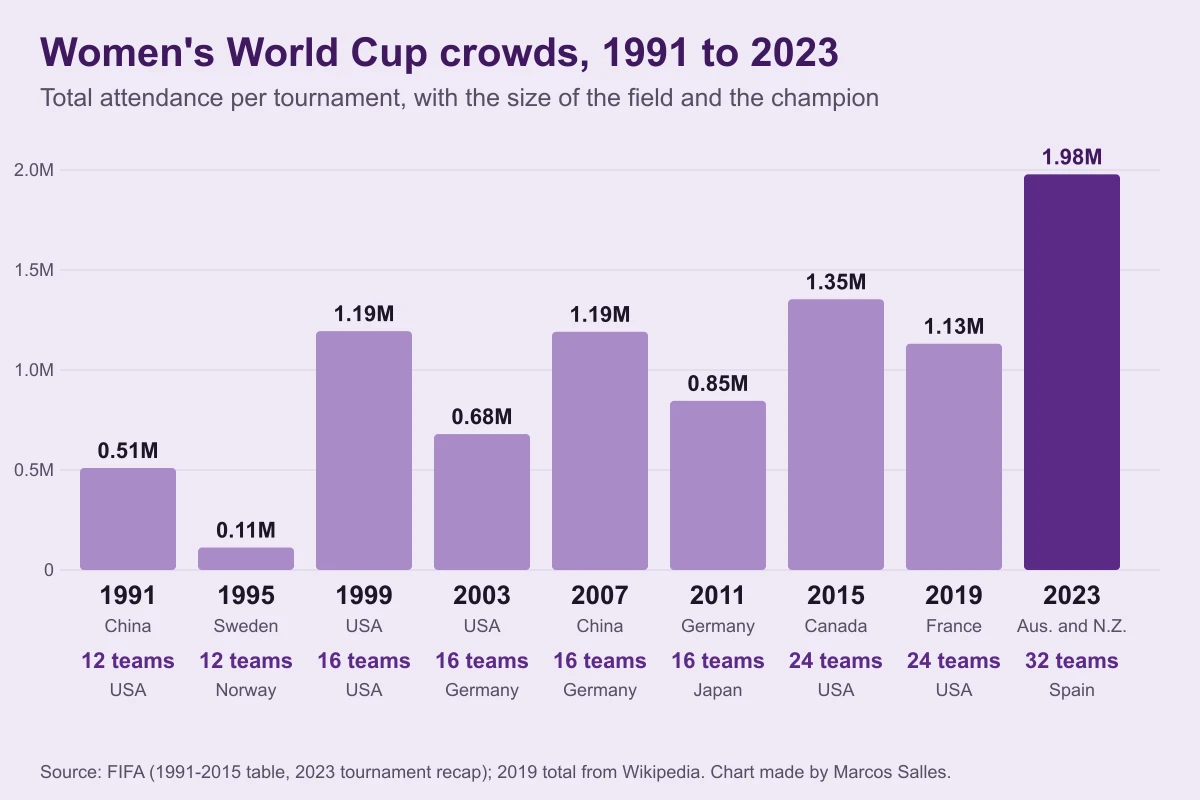
Five nations have won the Women's World Cup in nine tournaments since 1991: the United States four times (1991, 1999, 2015 and 2019), Germany twice (2003 and 2007), and Norway (1995), Japan (2011) and Spain (2023) once each. The field grew from 12 teams to 32, and the crowds from about 112,000 in 1995 to almost two million in 2023. Brazil 2027 will be the tenth edition.
On this page
- Who has won the Women's World Cup?
- How did the tournament start in 1991 and 1995?
- Why does the 1999 World Cup still matter?
- What happened between 2003 and 2011?
- How did the tournament change from 2015 to 2023?
- Which teams came close but never won?
- What does this history mean for the 2027 World Cup in Brazil?
- FAQ
- Sources
The Women's World Cup has been played nine times since 1991, and only five countries have lifted the trophy. The United States hold four of the nine titles, so the list is easy to remember. The story behind it is more interesting than the list.
Below are all nine champions and finals, how the tournament grew from 12 teams in China to 32 teams in Australia and New Zealand, and what that history tells you before the tenth edition starts in Brazil.
Who has won the Women's World Cup?
Five national teams have won it. The United States lead with four titles, Germany have two, and Norway, Japan and Spain have one each. Ten teams in all have played in a final, which means Brazil, China, the Netherlands, Sweden and England have reached one and lost it.
| Year | Host | Champion | Score | Runner-up | Final venue and crowd |
|---|---|---|---|---|---|
| 1991 | China | United States | 2-1 | Norway | Guangzhou, about 63,000 |
| 1995 | Sweden | Norway | 2-0 | Germany | Stockholm, 17,158 |
| 1999 | United States | United States | 0-0 (5-4 on penalties) | China | Pasadena, 90,185 |
| 2003 | United States | Germany | 2-1 (golden goal) | Sweden | Carson, 26,137 |
| 2007 | China | Germany | 2-0 | Brazil | Shanghai, about 31,000 |
| 2011 | Germany | Japan | 2-2 (3-1 on penalties) | United States | Frankfurt, 48,817 |
| 2015 | Canada | United States | 5-2 | Japan | Vancouver, 53,341 |
| 2019 | France | United States | 2-0 | Netherlands | Lyon, 57,900 |
| 2023 | Australia and New Zealand | Spain | 1-0 | England | Sydney, 75,784 |
Every Women's World Cup final since 1991. Source: Wikipedia's list of finals, checked against FIFA for 1999 and 2023. Attendance of the final is rounded for 1991 and 2007.
Only two countries have won back to back: Germany in 2003 and 2007, and the United States in 2015 and 2019. Three finals needed more than 90 minutes to find a winner, in 1999, 2003 and 2011.
How did the tournament start in 1991 and 1995?
The first Women's World Cup was played in China from November 16 to 30, 1991, with 12 teams and 26 matches. The United States beat Norway 2-1 in the final in Guangzhou, and Michelle Akers finished as top scorer with 10 goals.
Sweden hosted the second edition in 1995, with the same 12 teams. Norway beat Germany 2-0 at the Råsunda Stadium in Stockholm on June 18, but the final drew 17,158 people. FIFA's own history says the whole tournament averaged fewer than 4,500 fans a match, for a total of 112,213. That small number is the key to the next chapter.
Why does the 1999 World Cup still matter?
Because organizers took a risk that paid off. FIFA says the original plan for 1999 was a far smaller event in small stadiums on the U.S. East Coast. Then the United States won the 1996 Olympic gold medal in front of 76,489 people, and the organizers changed course: a coast-to-coast tournament in the big stadiums used for the men's World Cup in 1994.
The players were nervous. U.S. star Kristine Lilly said they did not want to play "before empty stands in big stadiums." They did not have to. The tournament drew about 1.19 million fans across 32 matches, an average of 37,319 a game, and that average is still the highest of any edition.
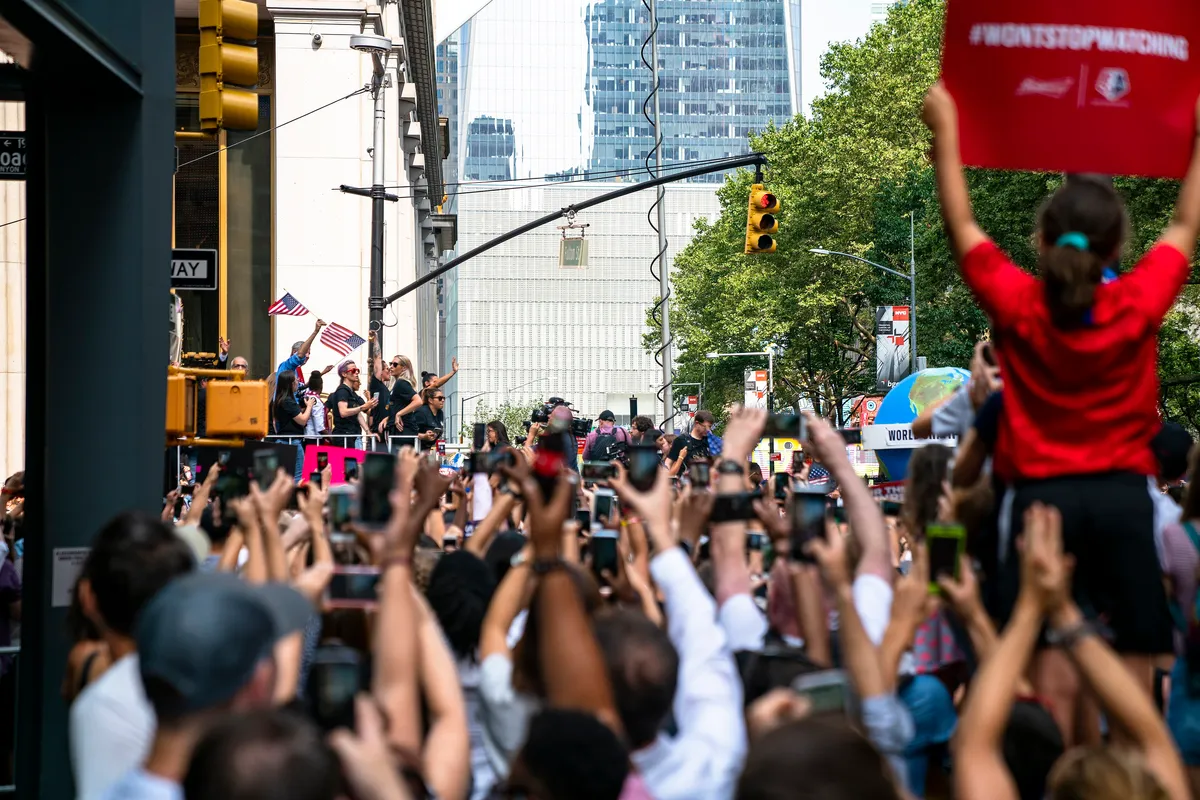
The final was played at the Rose Bowl in Pasadena on July 10, 1999, in front of 90,185 fans, including then President Bill Clinton. It ended 0-0 after extra time, and the United States beat China 5-4 on penalties. Brandi Chastain's title-winning celebration made the covers of Newsweek, Sports Illustrated and Time. If I had to pick the moment women's soccer became a stadium event, I would pick this tournament.
What happened between 2003 and 2011?
China was supposed to host the 2003 tournament, but FIFA moved it to the United States because of a major SARS outbreak. China kept its automatic place as a host and was given the 2007 edition as compensation. Germany won in Carson, California, beating Sweden 2-1 with a golden goal in extra time, and Birgit Prinz was top scorer with 7 goals.
Germany repeated in China in 2007, beating Brazil 2-0 in Shanghai, the first time a country won two editions in a row. Marta scored 7 goals in that tournament. The final remains Brazil's best result at a Women's World Cup, which is one more reason the 2027 edition at home will be watched closely there.
In 2011, Germany hosted, and the final in Frankfurt was a classic: Japan and the United States drew 2-2, and Japan won 3-1 on penalties. Homare Sawa was top scorer with 5 goals. Japan became the fourth different champion, after the United States, Norway and Germany.
How did the tournament change from 2015 to 2023?
It got bigger every time. Canada 2015 expanded the field to 24 teams and 52 matches. The United States beat Japan 5-2 in the final at BC Place in Vancouver, and the tournament drew 1,353,506 fans, the biggest total up to that point.
France 2019 kept the 24-team format. The United States won again, 2-0 against the Netherlands in Lyon, in front of 57,900 people. FIFA says the broadcast coverage was watched by 1.12 billion viewers, and the final alone had an average live audience of 82.18 million.
Australia and New Zealand 2023 was the first tournament with 32 teams and 64 matches. FIFA counted eight debutants. Spain beat England 1-0 in the final at Stadium Australia in Sydney on August 20, 2023, with the only goal from Olga Carmona, in front of 75,784 supporters. FIFA reports 1,978,274 fans in the stadiums over the whole tournament and more than 1.8 million tickets sold. The chart below puts every edition side by side.
Spain's title was also the first new champion since Japan in 2011. After the final, FIFA noted that Spain had become the first nation to hold the U-17, U-20 and senior world titles at the same time.

Which teams came close but never won?
Sweden are the best example. They reached the 2003 final and finished third in 1991, 2011, 2019 and 2023, five podium finishes without a title. The others that lost a final are China in 1999, Brazil in 2007, the Netherlands in 2019 and England in 2023.
The five champions have lost finals too: the United States in 2011, Norway in 1991, Germany in 1995 and Japan in 2015. Spain's 2023 title was their first final.
What does this history mean for the 2027 World Cup in Brazil?
The 2027 Women's World Cup will be the tenth edition and the first in South America, with 32 teams playing 64 matches from June 24 to July 25. For the dates, host cities and knockout bracket, read my schedule guide; for the teams already in, read the guide to the qualified teams. Spain arrive as the reigning champions.
My read is that no country is a lock. Five different nations have won in nine tournaments, and the latest champion, Spain, had never played a final before 2023. The United States are still the team to beat on paper, and their build-up is in my USWNT road to Brazil piece. Brazil have never won, and their best result is that 2007 final, so the hosts have a clear story to write.
If you want to be in the stands for the next chapter, how to get tickets and traveling to Brazil are the two guides to read next. Netflix holds the U.S. rights, and the languages and time zones are covered in how to watch the 2027 Women's World Cup.
Frequently asked questions
Who has won the most Women's World Cups?
The United States, with four titles: 1991, 1999, 2015 and 2019. Germany have two (2003 and 2007), and Norway (1995), Japan (2011) and Spain (2023) have one each.
Who won the most recent Women's World Cup?
Spain, who beat England 1-0 in the final at Stadium Australia in Sydney on August 20, 2023. Olga Carmona scored the only goal, in front of 75,784 fans.
How many times has the Women's World Cup been played?
Nine times since the first tournament in China in 1991. The 2027 edition in Brazil will be the tenth, and the first played in South America.
Has Brazil ever reached a Women's World Cup final?
Once, in 2007, when Germany won 2-0 in Shanghai. Brazil have never lifted the trophy, and 2027 is the first time they host the tournament.
What was the biggest crowd at a Women's World Cup final?
The 1999 final at the Rose Bowl in Pasadena, California, with 90,185 fans. The United States beat China on penalties after a 0-0 draw. The 2023 final drew 75,784.
How many teams have played in the Women's World Cup?
The field has grown from 12 teams in 1991 and 1995 to 16 in 1999, 24 in 2015 and 32 in 2023. Brazil 2027 keeps the 32-team format.
Sources
- FIFA: The 1999 gamble that paid off, with attendance figures for 1991 to 2015 (Feb. 21, 2019)
- FIFA: FIFA Women's World Cup 2023 tournament recap (attendance and tickets), read Oct. 30, 2026
- FIFA: FIFA celebrates 100 days since the FIFA Women's World Cup 2023 Final, read Oct. 30, 2026
- FIFA: FIFA Women's World Cup 2023 breaks new records (July 25, 2023)
- FIFA: 2019, a breakthrough year for women's football (viewing figures), read Oct. 30, 2026
- Wikipedia: List of FIFA Women's World Cup finals (scores, venues, final attendances), read Oct. 30, 2026
- Wikipedia: FIFA Women's World Cup (champions by nation, 2003 relocation, 2019 total attendance), read Oct. 30, 2026
- Wikipedia: 2019 FIFA Women's World Cup (dates, teams, matches), read Oct. 30, 2026

Founder and editor, WoSo Arena
I live in Salvador, Brazil, one of the eight host cities of the 2027 Women's World Cup, and I spent five years in the United States, where girls' and women's games filled the parks and school fields of Los Angeles. Every article starts from official sources, listed at the end.