Girls' Youth Soccer
Soccer Cleats for Girls: How to Choose the Right Pair
Quick answer
Choose the sole for the field first, then the fit. Firm-ground (FG) is the most common sole and is made for natural grass, while turf and indoor courts call for different soles, so ask your club which surface you play on. Then try the pair on with your game socks: heel held, no pinching, no big gap to grow into. Shin guards are compulsory under the Laws of the Game.
On this page
- What do the rules say you have to wear?
- Which sole is right for your field?
- Can you wear firm-ground cleats on turf?
- How should girls' cleats fit?
- Should you buy a bigger pair to grow into?
- Do you need cleats made for women?
- Which level and style do you need?
- What should you check before you buy?
- What should you read next?
- FAQ
- Sources
The first pair of cleats is a small purchase that comes with a lot of letters on the box: FG, AG, TF, MG. I am not a coach, a podiatrist or a shoe seller, and this site is independent of every brand named here. So I read what the Laws of the Game, AYSO, Nike, adidas, Puma and two retailer guides actually say, on October 31, 2026, and boiled it down to the few decisions that matter when you choose a pair.
The guide covers what the rules require, which sole fits your field, how the pair should fit, and whether a women's fit is worth a look. Cleats are one line in a bigger budget and plan, and my pillar guide on how girls' club soccer works covers the rest.
What do the rules say you have to wear?
The Laws of the Game list the compulsory equipment of a player: a shirt with sleeves, shorts, socks, shin guards and footwear. The Law says "footwear," not "cleats," so the studs themselves are a question for your league.
Shin guards are the part with detail. Law 4 says they must be made of a suitable material, be of an appropriate size to provide reasonable protection, and be covered by the socks. It adds that "players are responsible for the size and suitability of their shinguards." AYSO's referee FAQ is more concrete: shoes and shin guards from an established soccer manufacturer are acceptable, "a piece of cardboard rolled up newspaper or similar makeshift items" are not shin guards, and referees are told to inspect cleats for sharp edges.
That gives you a simple starting list: real shin guards in your size, socks that cover them, and a pair of cleats in good shape that your league allows. Ask the league about studs before you buy.
Which sole is right for your field?
Soles are named for the surface they are made for, and the letters on the box are the fastest way to narrow the choice. Nike's guide, published June 5, 2026, describes six types. I drew them below.
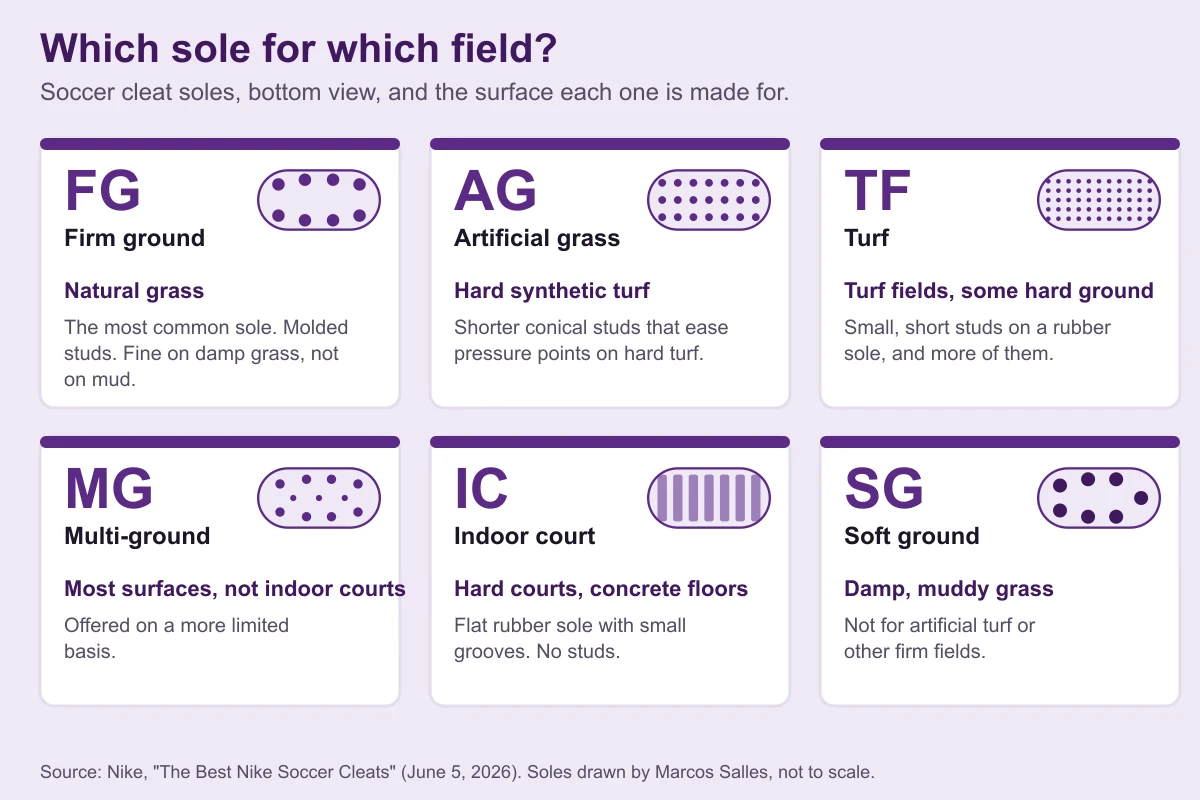
FG is the one you will see most, with molded studs for natural grass. Nike says to try not to use it on muddy fields, though damp ones are fine. SG is the long-stud version for damp, muddy grass, and Nike says it should not be worn on artificial turf or other firm fields.
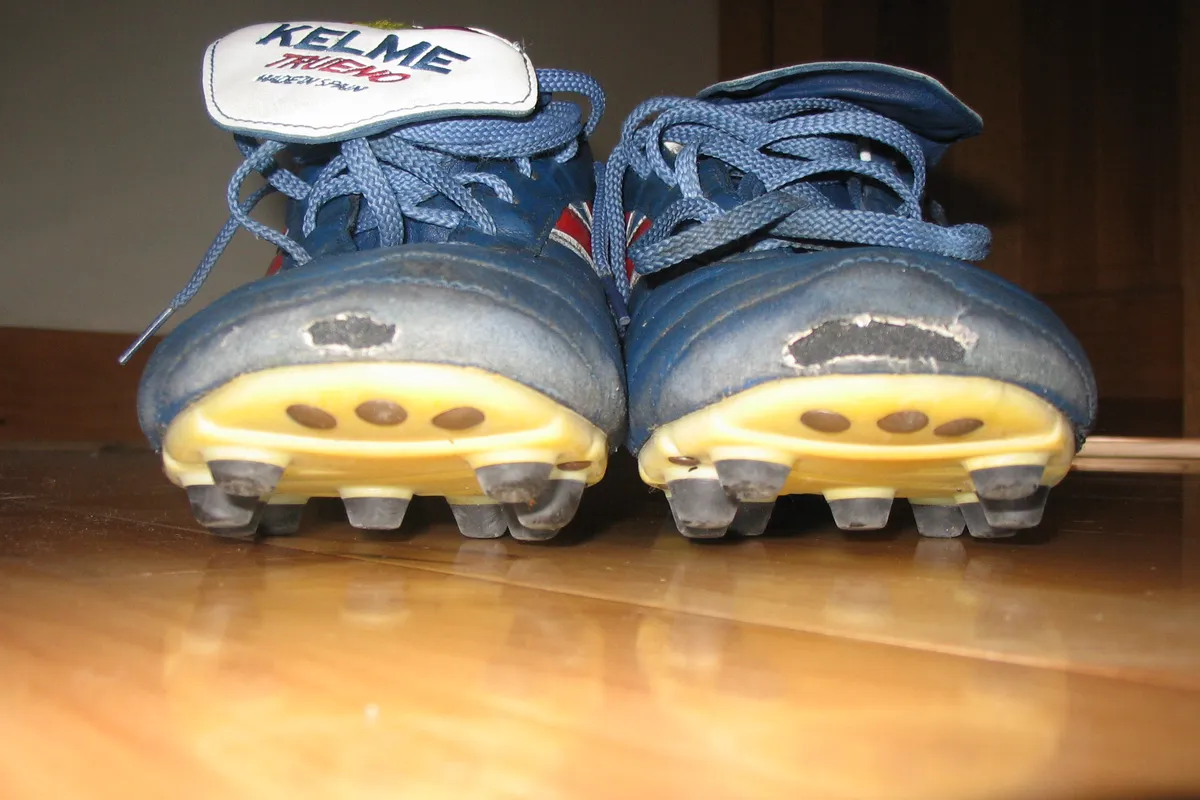
Treat the letters as a starting point. Pro Soccer's guide puts it this way: "The label is a starting point, not a universal promise." It says multi-ground (MG) is specific to each model and that the same abbreviation can cover different surfaces from one brand to the next, so it tells you to check the manufacturer's guidance for the exact cleat.
Can you wear firm-ground cleats on turf?
The sources I read do not say exactly the same thing, which is a good reason to ask before you buy. Nike lists FG for groomed fields "or artificial fields with longer turf blades" and describes AG as the choice for relatively hard synthetic surfaces. Academy Sports + Outdoors says FG is "traditionally used outdoors on grass fields and artificial grass" and calls AG "a good backup cleat for hard surface play." Pro Soccer is the most careful: "Do not assume an FG model is suitable for artificial turf," and check the manufacturer's guidance and the facility's rules.
Here is how I would settle it. Ask your club or league what the surface is, and what footwear it allows, then match the box to that answer. If you play on grass and on turf, Nike says MG works on most surfaces except an indoor court or concrete floor, and Pro Soccer says an MG model may be practical if the manufacturer lists the surfaces you use. If one model does not cover your fields, two pairs can be the simpler answer. Indoor shoes are a separate pair, with a flat sole and no studs.
How should girls' cleats fit?
Pro Soccer's fit advice is the clearest I found, and it works for any age. Try the pair on with the socks you play in and any inserts your league permits, then check three things:
- Heel: it stays secure when you walk and move.
- Width: your foot is not squeezed across the widest part.
- Toes: they have comfortable space, without letting the foot slide around.
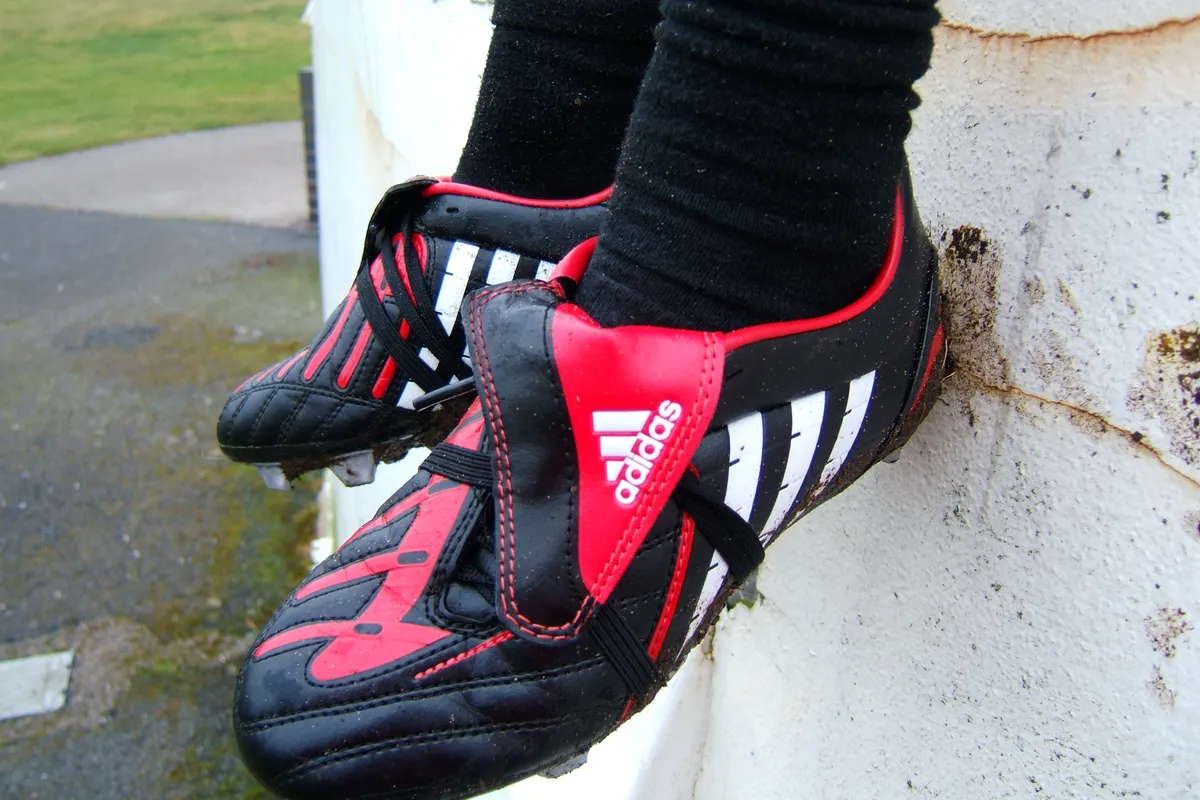
The same guide says a close fit helps prevent movement inside the shoe, but "snug should not mean painful, numb, or compressed." It also suggests comparing both feet, since they may not match, and trying a different size or shape if one foot slips or pinches. If I were shopping, I would bring your shin guards too, because they sit under the same socks and change how the shoe feels.
The same goes for anything you wear on your ankles. When I play, I wrap both ankles with an elastic bandage to feel steadier, and with the sock pulled over the whole wrap my foot has sometimes not fit in the cleat at all. In that case I went up one size. But if the bigger pair still feels loose with the wrap on, I would rather use less bandage and go back to the smaller size than keep a pair where the foot slides. If you tape, wrap or wear a brace, bring it to the store and try the pair with it on.
Do not rely on a size conversion. Pro Soccer says US men's, US women's, youth, UK and EU sizes "should not be treated as a single universal scale," and tells buyers to use the brand's own chart. Academy's guide suggests a half-size smaller than your street shoe size. I would trust the try-on over any rule of thumb, especially if you are still growing.
Should you buy a bigger pair to grow into?
It is the most common shortcut, and the sources I read advise against it. Pro Soccer says not to buy cleats so large that the foot shifts inside them in anticipation of growth, and adds that a fixed extra-space rule is not a reliable substitute for trying them on. AYSO's injury-prevention tips, published in December 2018, list big or small cleats, and old worn-down ones, among the things that can increase the chance of various injuries.
So the better habit is to recheck. Pro Soccer says to check the fit again as growth continues, and I would do that at the start of each season and any time your toes feel tight. If the cost of a new pair every year is the worry, the next section is the cheaper answer: a lower tier that fits well beats a top tier that does not. The fee sheets in my club soccer budget guide show where gear sits next to the other costs.
Do you need cleats made for women?
Several brands now say their women's models fit differently, and the wording is worth knowing. adidas says in its June 2025 launch release for the F50 SPARKFUSION that "female feet typically have a narrower heel, higher arches and more volume around the midfoot area," and built a women's last it calls FUSIONLAST for that. Puma describes a women's version of its FUTURE 8 with "a slimmer fit tailored to the anatomy of a woman's foot," and its product page says volume and instep height are engineered for the female foot. Puma also says its boots come "in both unisex and women's fits," so the choice is open.
These are the brands' own claims, and I have not tested them. I also did not find whether these women's lines come in girls' sizes, so check the size chart for your size. My view is simple: if the fit of a unisex pair feels loose in the heel or tight across the instep, a women's fit is a fair next thing to try on. Fit is what decides it, and Nike's guide shows that fit varies inside one brand too. It says its Tiempo and Phantom lines work well for wide feet, while the Mercurial has a snugger fit.
Which level and style do you need?
Brands sell the same cleat in tiers. Nike describes four: Elite for competitive and professional play, Pro for serious club and competitive players, Academy as mid-range and "good for recreational and developing players," and Club for beginners and casual players. Pro Soccer says it directly: "Recreational players do not need a top-tier model simply because it is available." A lower-priced version can be the sensible option when it fits well and has the right sole.
Two other things can wait. Nike says the height of the cleat, low or high, likely will not change performance, and Pro Soccer says no position determines one correct upper or stud pattern. It also warns that "a professional player's model is not a fit prescription." If you have a favorite player's cleat, that is a fine reason to try it on, not a reason to buy it unseen.
What should you check before you buy?
- Ask what surface you play on, and what your league allows on the feet.
- Match the sole letters to that surface, and read the manufacturer's guidance for the exact model.
- Try the pair on with your game socks, shin guards and any ankle wrap or tape you use, following the brand's size chart.
- Check the heel, width and toes on both feet, standing and walking.
- Skip the oversized pair, and recheck the fit each season.
- Look at the old pair before you reuse it: sharp edges and worn-down cleats are worth a second look.
If anything hurts, Pro Soccer's advice is to stop wearing the cleat and reassess the fit instead of playing through it.
What should you read next?
If your team has not been picked yet, my ECNL vs. Girls Academy guide lays out the two top leagues side by side, and the age-group guide explains how a birth date becomes a team letter. Looking further ahead, the college recruiting timeline maps the path after club soccer, and the rest of my parent guides sit under Girls' Youth Soccer. The pages cited above were read on October 31, 2026, and I will update this guide if they change.
Frequently asked questions
What cleats should you wear on grass?
Firm-ground (FG) cleats are the most common type and are made for natural grass, according to Nike's guide. Nike says to try not to use them on muddy fields, and that soft-ground (SG) cleats are the choice for damp, muddy grass. Check the exact model's guidance.
Do you have to wear cleats to play soccer?
The Laws of the Game list "footwear" and shin guards as compulsory equipment, not cleats by name. Whether studs are required or allowed depends on the league, so ask your club before you buy.
Can you wear firm-ground cleats on artificial turf?
The sources differ. Nike lists FG for artificial fields with longer turf blades, while Pro Soccer says not to assume an FG model suits artificial turf. Ask the club or league about the surface and footwear rules, and check the manufacturer's guidance for the model.
How much room should soccer cleats have?
Pro Soccer says the heel should stay secure, the foot should not be squeezed across its width, and the toes should have comfortable space. Try them on with your game socks and any permitted inserts, and compare both feet.
Should you buy cleats a size bigger to grow into?
The guides I read advise against it. Pro Soccer says not to buy cleats so large that the foot shifts inside them in anticipation of growth, and AYSO lists big or small cleats among the things that can increase the chance of injury. Recheck the fit as you grow.
Do you need a bigger size if you wrap your ankles?
Sometimes. When I play, I wrap my ankles with an elastic bandage, and with the sock over the wrap the foot has not always fit, so I went up a size. If the bigger pair feels loose even with the wrap on, I would use less bandage and return to the smaller size. Try the pair on with whatever you wear.
Are women's soccer cleats better for girls?
Brands such as adidas and Puma say their women's models are shaped for a narrower heel and different instep and volume. Those are the brands' own claims, and fit varies by model, so try a women's fit on if a unisex pair feels loose in the heel or tight across the instep.
Do you need expensive cleats?
No, according to the guides I read. Nike describes its Academy tier as good for recreational and developing players and its Club tier as best for beginners, and Pro Soccer says recreational players do not need a top-tier model. A pair that fits and has the right sole matters more.
Sources
- IFAB: Laws of the Game 2026/27, Law 4 The Players' Equipment, read Oct. 31, 2026
- AYSO Wiki: Referee FAQ for players (shoes, shin guards, cleat inspection), read Oct. 31, 2026
- AYSO: 7 Tips to Reduce Injury (Dec. 18, 2018), read Oct. 31, 2026
- Nike: The Best Nike Soccer Cleats (June 5, 2026), read Oct. 31, 2026
- Pro Soccer: Different Types of Soccer Cleats, a guide to every surface, read Oct. 31, 2026
- Academy Sports + Outdoors: How to Choose the Right Soccer Cleats, read Oct. 31, 2026
- adidas: F50 SPARKFUSION launch release (June 17, 2025), read Oct. 31, 2026
- PUMA: FUTURE 8 launch release (2025), read Oct. 31, 2026
- PUMA: FUTURE 8 PLAY Firm Ground/Artificial Ground Women's Soccer Cleats (product page), read Oct. 31, 2026

Founder and editor, WoSo Arena
I live in Salvador, Brazil, one of the eight host cities of the 2027 Women's World Cup, and I spent five years in the United States, where girls' and women's games filled the parks and school fields of Los Angeles. Every article starts from official sources, listed at the end.